Lydia HudsonThe Cybersecurity Sophistication Paradox
Why Your Million-Pound Defence Still Fails Against Basic Attacks
Executive Summary
The cybersecurity industry faces an uncomfortable truth. Whilst organisations invest millions in AI-powered threat detection and quantum-resistant encryption, the majority of data breaches still result from basic security failures. Unpatched systems, weak passwords, and human error continue to devastate businesses, despite their deployment of the most sophisticated security technologies available.
This paradox costs the global economy billions annually. According to IBM’s 2024 Cost of a Data Breach Report, the average data breach now costs $4.88 million, with healthcare organisations facing costs exceeding $9.77 million per incident. The disconnect between security spending and actual protection has never been starker.
Companies achieving the lowest breach rates prioritise comprehensive asset visibility, working endpoint detection and response (EDR) deployment, patch management, and end-of-life equipment replacement over expensive detection platforms.
This white paper exposes a critical paradox: whilst cybersecurity budgets chase advanced threats, most breaches succeed through basic failures that proper controls could prevent. It provides CISOs with a strategic framework for resolving this paradox through balanced investment in prevention and detection capabilities.
Introduction: The Modern Security Delusion
The cybersecurity landscape presents a striking contradiction that defines modern enterprise risk management. Boardrooms approve budgets exceeding millions for AI-powered security platforms capable of detecting the most advanced persistent threats. Yet the same organisations suffer catastrophic breaches through unpatched servers and compromised service accounts with predictable passwords.
This isn’t theoretical. Real organisations with world-class security operations centres, staffed by certified professionals using cutting-edge tools, experience devastating incidents that fundamental security hygiene would have prevented entirely. The cognitive dissonance is profound. Security leaders who can articulate the nuances of advanced persistent threat campaigns struggle to explain why their environments remain vulnerable to attacks that exploit decade-old techniques.
The investments are substantial, the technologies impressive, and the expertise genuine. Yet breach frequency and severity continue rising. The global average cost of a data breach increased 10% over the previous year, reaching $4.88 million, the biggest jump since the pandemic. The sophistication paradox isn’t just an academic curiosity; it’s a business-critical problem demanding immediate resolution.
The stakes couldn’t be higher. More than half of breached organisations now pass security costs to customers through price increases, with 70% experiencing significant or very significant business disruption. In competitive markets already facing inflationary pressures, this approach risks customer flight and reputational damage.
The Reality of Advanced Threats
State-Sponsored Warfare in Cyberspace Nation-state attackers represent the pinnacle of cyber sophistication. Groups like APT41, Lazarus, and Cozy Bear demonstrate capabilities that seem to emerge from science fiction. Their operations span multiple continents, persist for years undetected, and employ techniques that challenge fundamental assumptions about digital security.
APT41, also known as Wicked Panda, exemplifies this sophistication. Active since 2012, this Chinese group conducts dual-purpose operations serving both espionage and financial objectives. Their technical arsenal includes advanced firmware implants that achieve persistence, surviving operating system reinstallation and hard drive replacement.
Their operational security is equally impressive. APT41 operations follow Beijing business hours (UTC+8, 9 AM - 7 PM), suggesting state resources and a professional structure. They’ve successfully compromised organisations across thirteen countries whilst maintaining covert access for months or years.
Recent innovations demonstrate their adaptability. In 2024, APT41 began using Google Calendar for command-and-control communications. This technique exploits the ubiquity of cloud services and the challenge of distinguishing malicious from legitimate traffic in enterprise environments.
Supply Chain Compromises at Scale The SolarWinds attack of 2020 demonstrated the supply chain compromise potential. Beginning in September 2019, attackers spent months perfecting their approach within SolarWinds’ development environment. The resulting SUNBURST malware, distributed through legitimate software updates, affected approximately 8,000 customers, including multiple US government agencies and Fortune 500 companies.
The technical sophistication was remarkable. Attackers implemented domain generation algorithms for unique command-and-control communication per victim. They programmed sophisticated dormancy periods to evade detection and signed their malware with legitimate SolarWinds certificates.
Supply chain attacks continue evolving. The Kaseya VSA incident in July 2021 exploited zero-day vulnerabilities to compromise managed service providers and their downstream customers. Within hours, REvil ransomware had encrypted systems at 800-1,500 businesses. The supermarket chain Co-op Sweden was forced to close 800 stores when their cash register software was compromised through their managed service provider.
AI-Powered Attack Evolution Artificial intelligence has fundamentally transformed threat capabilities. Threat actors now deploy AI across the entire attack lifecycle, from initial reconnaissance through payload delivery and persistence maintenance. The democratisation of AI tools enables even unsophisticated attackers to employ techniques previously reserved for advanced persistent threat groups.
AI-generated phishing campaigns have achieved unprecedented success rates. Traditional phishing relied on template messages with obvious grammatical errors and suspicious formatting. Modern AI systems generate personalised messages that incorporate publicly available information about targets, their organisations, and current events. The messages are grammatically perfect, contextually relevant, and emotionally compelling.
Self-modifying malware represents the next frontier. Advanced ransomware variants now use AI algorithms to adapt encryption strategies in real-time based on system characteristics and defence responses. These capabilities transform malware from static threats into adaptive adversaries. Zero-Day Exploitation at Industrial Scale Zero-day vulnerabilities represent an immediate compromise without warning. The targeting has shifted dramatically toward network edge devices, with attackers understanding that compromising security infrastructure provides the broadest access to protected networks.
VPN gateways, firewalls, and security appliances become attack platforms rather than defensive barriers.
Zero-day brokers have industrialised vulnerability trading. The rapid exploitation, often within days of discovery, demonstrates sophisticated vulnerability research capabilities that continue to challenge traditional defensive approaches.
Quantum Computing Threats “Harvest now, decrypt later” attacks represent a unique long-term threat. Adversaries are currently collecting encrypted data with the expectation that future quantum computers will break current encryption standards. The “Y2Q” (Years to Quantum) timeline creates a cryptographic cliff where today’s secrets become tomorrow’s vulnerabilities.
NIST’s release of post-quantum cryptography standards in 2024 marks the beginning of a massive transition. Organisations must inventory their cryptographic implementations, prioritise long-term sensitive data, and begin the complex process of transitioning to quantum-resistant algorithms, all whilst current encryption remains secure.
Secure Every Device in Your Network
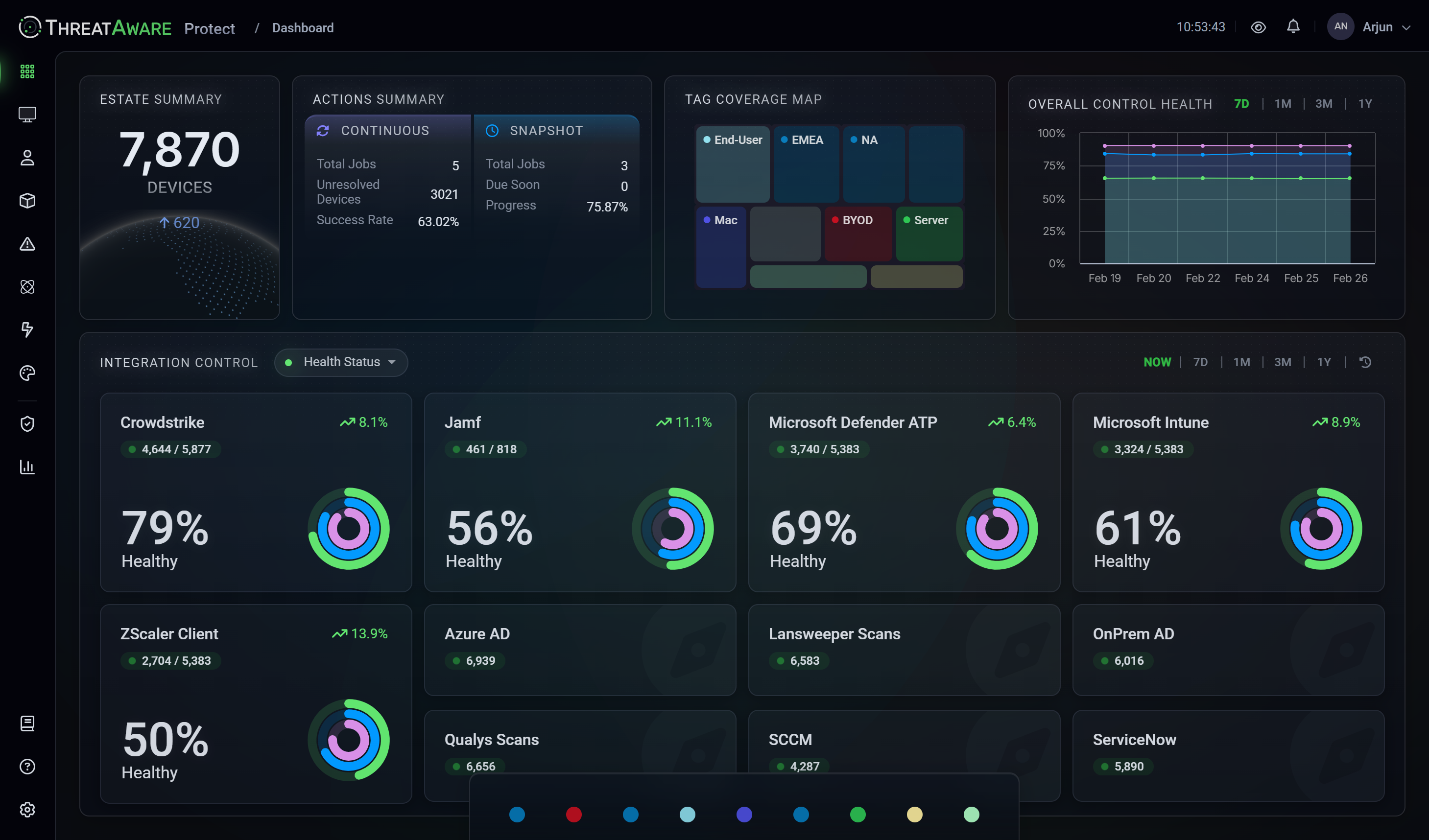
Instantly uncover and protect every asset in your IT estate with ThreatAware.
Identify unknown devices, reconcile asset data across platforms, and eliminate security gaps to ensure continuous cyber hygiene.
Book a Demo