How the IT operations team at Ann Summers got a security view it can trust
Ann Summers runs 68 stores, two warehouses and a head office with a lean IT team that also looks after cybersecurity. The team had a credible set of security tools, but each lived in its own portal, and none showed the full picture across the estate.
Chris Rolfe
IT Operations Lead, Ann Summers
About Ann Summers
One of Britain’s best-known high street brands, serving customers in stores and online across the UK and Ireland.
Meet Ann Summers
A high street name with a lean operation behind it
Ann Summers has been one of the most recognisable names on the high street for more than 50 years. Today it runs 68 stores across the UK and Ireland, supported by a head office and two warehouses. Depending on the time of year, between 1,200 and 1,500 people work for the business, and the IT estate runs to roughly 550 to 650 endpoints.
Many of those stores are small, often with two to four staff and an internet connection that can be patchy at times. That makes fixing problems remotely very difficult, wherever the store is. Then there’s peak season, from the end of October to Valentine’s Day. During those months, support work takes over and it becomes hard to make changes, run projects or install new kit on site. That leaves around nine months of the year for everything else.
Keeping all of that running falls to Chris Rolfe, IT Operations Lead at Ann Summers. He has worked in IT since 1999, in technical roles across many industries that gave him a strong grounding in infrastructure. He joined Ann Summers nine years ago in an engineering role, moved into management and now leads the team across support, infrastructure and application support.
His remit is wide. He’s responsible for all technical operations and manages a technology budget covering multiple vendors. He’s also responsible for cybersecurity, which he runs alongside his team. He reports on it to the board every quarter.
“It’s been a long career in IT,” he says. “I still enjoy it.”
Challenge
The problem: a fragmented view of security
On the security side, the existing tools themselves weren’t the issue for the team. Ann Summers had good antivirus and firewalls. The problem was seeing across them. It’s a common pattern: as security tools multiply, each one reports on its own corner of the estate, and none shows the whole picture. Chris's engineers were constantly moving between portals, trying to keep up with where the business stood, with the antivirus console and the asset register in their service desk tool as the closest things to a source of truth.
That was compounded every quarter, when Chris reported to the board. More tools meant more to manage. “We were building the security tooling up and not really simplifying our lives,” he says. His job wasn’t to prove there were problems, it was to prove there weren’t. Which is hard to do without seeing across everything.
With attacks on retailers also in the news over the past couple of years, Chris wanted complete visibility across the estate. “The problem is the unknown,” he says. “It’s what you don’t know.” Most security gaps are straightforward to close, in his experience. “It’s the 20% and less that are the difficult things to get at.”
Finding a tool to fix that wasn’t simple. Many products on the market were priced for much larger organisations.
“The problem is the unknown. It’s what you don’t know.”
Solution
From expo stand to Proof of Value
The turning point came at a security trade show, where one of Chris’s senior engineers met ThreatAware on its stand. He brought the idea back to the team, and it resonated.
The team started a Proof of Value, which was up and running quickly. Because ThreatAware connects to existing tools through their APIs, there was no new agent to deploy. Chris sees that as a real plus. A typical laptop already runs around 10 different agents, he says, each doing a different job and adding overhead to the device. “Anything to avoid that is always a positive step.”
Then they hit a snag. Ann Summers’ antivirus product wasn’t yet among ThreatAware’s integrations. ThreatAware’s development team built one in 48 hours. “I was gobsmacked,” Chris says. “I kind of was expecting it to fall over at that point, but it didn’t.”
In his experience, larger vendors can’t always adapt their products to one customer’s needs. “With ThreatAware it wasn’t like that,” he says. “There was a gap there that wasn’t going to work for us as a customer, and you plugged the gap.” That speed and flexibility, he says, “definitely sealed the deal”.
“I was gobsmacked.”
During the trial, Chris heard from another ThreatAware customer about Stealth Device Detection, which finds devices that sit outside a team’s existing management tools. ThreatAware switched it on for Ann Summers the same day. “That gave us that additional visibility, which was great,” Chris says. It confirmed the estate was in good shape.
After a successful Proof of Value, Chris took a business case for ThreatAware to the board, which reviewed it and gave him the go-ahead on the spot.
Results
Used every day
The platform itself was a big selling point. “It’s very clean, very intuitive,” Chris says. “The guys took to it naturally. They could find their way around very easily. They could get the answers that they needed very quickly. They can really use it out of the blocks.” That meant no big investment of time or money in training. Chris has his own test of whether a tool is working.
Chris has his own test of whether a tool is working: “The tools that stick are generally the ones that are open on people’s devices every single day of the week.”
Tools that aren’t useful fade into the background. “But with ThreatAware that’s not the case. That’s something they’re actively working in because they can. They’re essentially making their lives easier, right? So why wouldn’t they do it?”
“The tools that stick are generally the ones that are open on people’s devices every single day of the week.”
Impact
The difference it’s made
The team has also restructured how it manages security. One person now has a ring-fenced day each week to focus on nothing but security, away from the support desk, working from ThreatAware as one of their primary sources of truth.
Even in the middle of a laptop rollout, the security figures the team tracks in ThreatAware are trending upwards. Chris is much more confident the team now spots problems in its other security tools sooner. They spend less time gathering information from different systems and resolve issues faster.
For Chris and his team, the biggest impact is confidence. “It’s a big confidence builder that you have got a view on the world which is actually true,” he says. “Often with these portals, as good as some of them are, there is often a little bit missing about where they’re not good.”
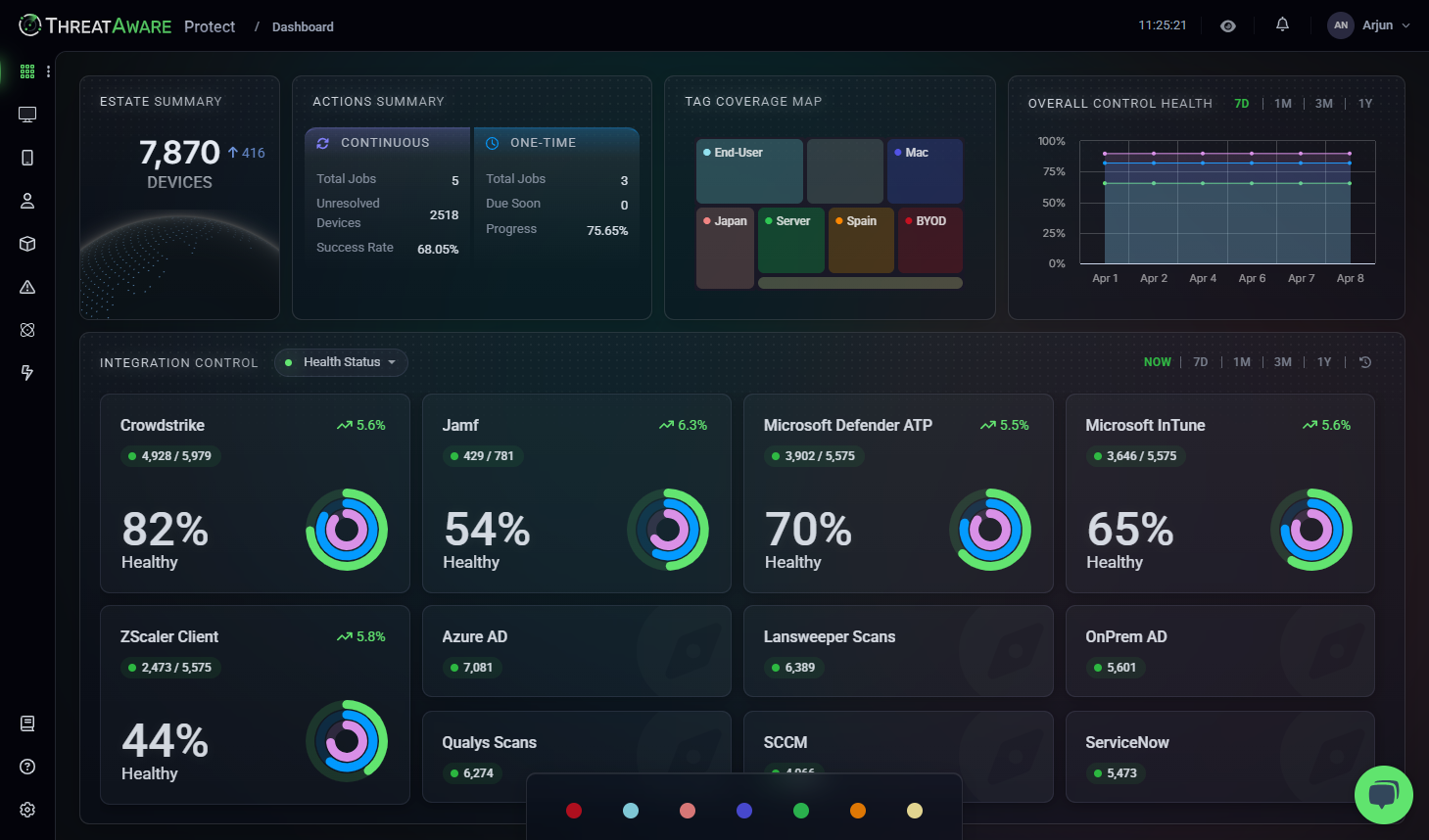
The quarterly board report that had been getting harder to put together now draws on the ThreatAware dashboard.
What’s next
Chris would like to explore ThreatAware’s AI Reporting and the Action Centre, which automates remediation workflows. His goal is to bring ThreatAware onto the big screen in the technology department, where data from the team’s systems is constantly on display.
Peak season is now underway, the busiest time of year for the business and the stretch when trading matters most. For a team looking after 68 stores, two warehouses and a head office, it’s no time for guesswork. Chris goes into it with something he didn’t have before: a view of the estate he can trust.
It’s a big confidence builder that you have got a view on the world which is actually true.
Share this case study
Ready to achieve the same visibility as Ann Summers?
Book your demo today.
- Connect your stack
- Know every device
- Close the gaps